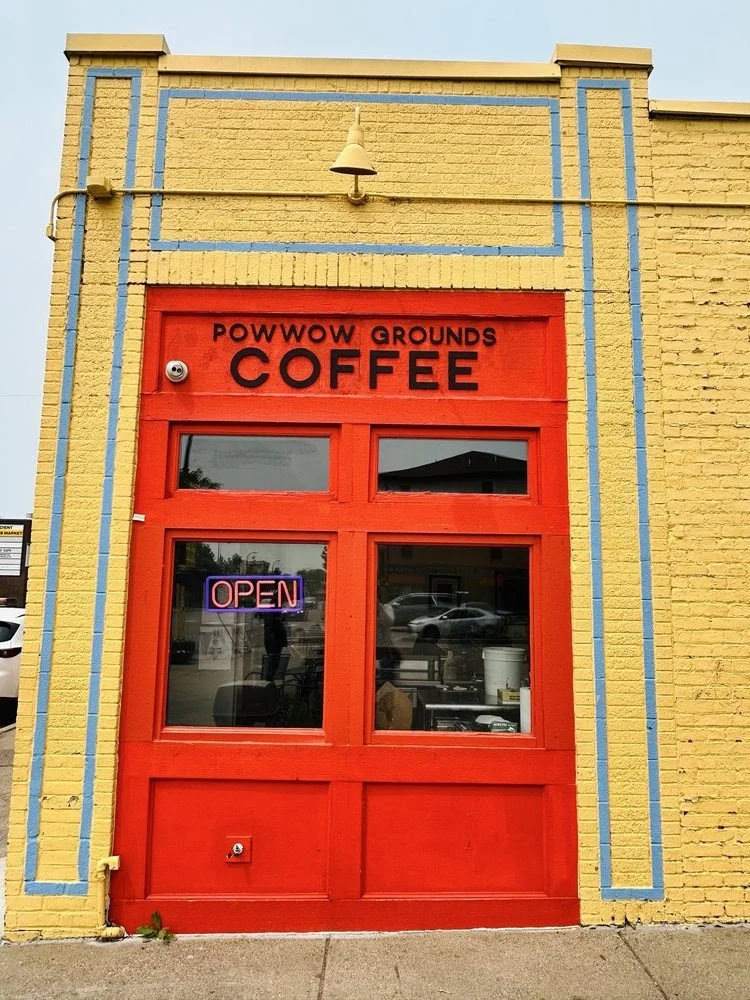
A Native-led Coffee Shop Steps up in Minneapolis
Edited Transcript of the Interview
Joanna (00:00)
So my first question is about the history of Pow Wow Grounds and your role in it, Winona. How did it come to be and how has community care and support been a part of its DNA from the start?
Winona (00:15)
Okay,
Well, Pow Wow Grounds opened in 2011. Robert Rice is a member of the White Earth Reservation and he owns Pow Wow Grounds. And ⁓ it's located in the cultural corridor in Minneapolis. It's along Franklin Avenue where there's a lot of native businesses and ⁓ in the heart of the urban native community here in Minneapolis. And Mr. Rice is my uncle. So I've worked at Pow Wow Grounds off and on since ⁓I want to say the summer of 2011. And now my role is a manager there at Pow Wow Grounds. And you know, just being a native-owned small business in general within the urban native community, that's, I don't know how to say that. That in itself is big.
And over the years, we've done a lot for the community in terms of, you know, we have a coffee shop, which is Pow Wow Grounds, and then we've expanded it to catering. And so we do a lot of catering events for, you know, businesses all over the Twin Cities area. And then two years ago, we opened up our food truck called Frybread Factory. And then in 2020, when, you know, after the murder of George Floyd, ⁓ there was a lot with everything that was going on. Pow Wow Grounds kind of became like a hub in the community. So, it was, Bob opened the doors and we became like a food bank and also like a patrolling area. So we would have like the American Indian Movement and other members in the community who would stand watch to protect the other, not just native businesses, there's a lot of Somali businesses in the area too to protect the area from looting ⁓ and any any other type of violence.
Little Earth community is not too far away either that's where a lot of urban natives live and there was just a lot of threats towards our community and our businesses. And so, you know, we had people there patrolling the areas overnight and making sure everything was safe. We fed the community, ⁓ became a food bank to help those in need during that time. And so when the ICE presence, you know, operation Metro Surge, really started getting intense here in Minneapolis, we kind of had a blueprint ⁓ for what to do. You know, we've done it before. ⁓ And we've done, you know, the Native community has been doing community led activism for decades, you know, since the sixties. And so we all kind of came together and jumped right back into the work that we did in 2020.
In terms of becoming that resource hub and patrolling and protecting our neighborhood and our neighbors and our community, as well as giving back. So we've completely opened our doors and started accepting donations to be able to provide protective gear to protesters and observers. And we've been providing free soup and free coffee every single day, extending our hours. And just really being a safe space in the community for natives and non-natives for everybody really.
Joanna (04:23)
Wow. That's a really moving and incredible response, Winona. In the past few weeks, it sounds like you all mobilized very quickly because of that blueprint you had. And what are experiences you or other members of the team have had in the past weeks that really stand out, either negative or positive?
Winona (04:44)
So my role lately is I run all of the socials. I'm going to cry even just thinking about it. I cry every day. ⁓ I run all the socials and when I'm there every day we get a lot of phone calls, you know, and it's people all over the country and sometimes we get international phone calls or messages, of people just reaching out with kind words and asking how to help and how to be of support. And it's incredible. It's, the phone rings all day. There's so many messages every day and all of it is so positive and people just wanting to help and you know, the world is watching and people really care. And yeah, wow, it's been so incredible. And with the donations we've had, we've had enough to fully stock our sites. And we've had so much overflow that we've been able to provide gear and non-perishable foods, diapers, formula, wipes, like all of these things to a lot of different organizations who are doing mutual aid, lot of different groups who knows where that stuff needs to go and families.
And that in itself is, it’s what keeps me going personally. It makes me feel less helpless. I can't be a frontliner. You know, I'm a mom. And so this is my small role that I can play to do something. And we're all doing it together as a team and as a community. And it's so incredible to be a part of it. I'm thankful.
Joanna (06:34)
I have like tears in my eyes just listening because it's like it's the light in the dark right now. So thank you for sharing that.
Jess (06:42)
It really is.
Joanna (06:44)
Jess, go ahead.
Jess (06:46)
⁓ I just know that our community of business leaders across the country and world are going to be, I mean, we all know how, sorry, I'm starting to get emotional. Just all of us intimately know how hard it is to run a business in general, you know, let alone in the context that y'all are facing. And then, ⁓yeah, just what it takes to shift, but then also the beauty of what rises up to meet the needs in the moment. ⁓ Anyway, it's my own emotional processing of that right now. But to that end, I'm curious, just like if you're speaking to another business owner, or staff member, like how would you describe some of the shifts you've made to change how you operate in response? ⁓ Like what's it taken on the back end? What does it look like? And how did you make those decisions?
Winona (07:44)
So, I mean, it takes a lot of collaboration, right? Bob and I are not doing this on our own, we're doing this in collaboration. Our coffee shop is in the same building as the, as NACD. And they're a nonprofit organization attached to that is a gallery called All My Relations Gallery, which is owned by NACD.
But it's a collaboration between us and this nonprofit and also community leaders from the American Indian Movement and the Indigenous Protectors Movement. And on the business admin side of things, you know, one of the hard things to do is, especially when you're a small business and you only have a certain number of employees, we really had to be aware when we extended our hours and extended how many days we were open, because we used to be closed on Sundays. Once we did that and we had to have more staff, ⁓ like almost immediately, right? We had to have two people per shift and the food truck got full staffed and we didn't operate that way before. And so it was kind of, we had to recognize too that we can't, obviously overwork our staff in such a high emotional and physical and mental exhausting time, right? So it was learning how to staff to be able to operate this way. Navigating volunteers has been really important. That's something we're still working on is getting more organized when it comes to volunteer work and getting trusted volunteers to help take the pressure off of us.
And you know, there's a little bit more of a vetting process that we've learned over time too, when it comes to volunteers, because unfortunately ICE is infiltrating mutual aid sites. And so there's so many things to worry about and to be cautious about that we've kind of been learning as time goes on and adjusting to those.
I think the previous experience of that, we've done this work before… really helped us snap into action this time. And we knew that we did not have the capacity to be a full food bank with perishable foods again, that we could handle non perishable foods. It's easier to manage. And we knew also there was a need for supplies for protesters and observers to stay safe. And so we kind of at the beginning, were just like, hey, we need to get some things to fuel protesters and observers in the community and people who are afraid to leave their homes. And as the weeks have gone on, we've just gotten more organized and have adjusted and readjusted and how we operate is just getting more and more organized as weeks go on and we're just kind of learning as we go.
Yeah, I'm trying to think of what else.
The collaboration has been a big part of it too… Like I said previously, it's just, you know, it's not just Bob and I, it's a big effort as a community. And I wouldn't say there's a board, but it's like an unofficial board of, you know, everybody, the leaders and organizers of each group, you know, that are coming together to make these adjustments and to help one another, you know, make those adjustments.
Jess (11:02)
Are there ways that y'all, in terms of the collaboration and co-creation, and I don't know, one of the things I hear on what you're sharing is just, ⁓ yeah, how power is shared and distributed, it sounds like, in how y'all operate as a business that allows resiliency in these moments. ⁓ I don't know if that resonates or not. I want to make sure I'm not projecting that upon what you're saying, but curious if there's ways that you think y'all have operated since the start as a business that make it easier in these moments to come together and collaborate and if others might be able to learn from that.
Winona (12:06)
I think for us, it's a little...
I'm trying to figure out the right way to say this. ⁓ I think for us, it's a little different, right? We're a native-owned business. ⁓ Most of us are indigenous, well, all of us are all indigenous. We all have, you know, a history of growing up in Minneapolis and living in Minneapolis as Indigenous people. And within this community that has always been about ⁓ community-led initiatives in everything that we do. So when it comes to times in crisis or in times of need in the community, we have a long history of operating in collaboration and community led.
And so I think for us, it was a natural, like all of this kind of naturally kind of comes to us in all groups. And it's things that we have been doing in our community for decades since you know, the founding of the American Indian Movement. These things have been happening within our community since then, since 1968, in organized way. So I don't think there was anything.I think it just kind of came naturally for us. If that answers your question.
Jess (13:31)
It does. That makes a lot of sense.
Winona (13:35)
And one thing I would like to add too is, you know, BIPOC communities here, especially in Minneapolis, we're such an extremely diverse city. And we have a long history in this state of activism and community led activism amongst different BIPOC communities. And I really do credit that to a lot of the work that is happening here in Minneapolis and how organized it is.
I think that really did lay a blueprint for in general how Minneapolis is responding to this ICE presence here.
Joanna (14:15)
Wow. ⁓ And Winona, you spoke a bit about how overwhelmingly positive the response has been. Are there specific things about the response to what Pow Wow Grounds is doing right now, that has surprised you from individuals or groups or people near or far like yeah, has there been any surprising response?
Winona (14:40)
I think it's just the volume of people reaching out to ask how they can support us or the volume of people who have made donations from our Amazon wishlist, monetary donations. The amount of people who have you know, came in to make physical donations and a lot of people, you know, like you guys who are hearing about us and are reaching out to ask us about our work and want to share our work with their networks. I think all of that in combination. I think it's just the sheer volume of support, that's been surprising. It blows me away some days. Yeah, it's the sheer volume.
Joanna (15:22)
Wow. It's like wonderful and that sounds like a lot of phone calls and stuff to field.
Winona (15:28)
It's exhausting.It's exhausting
Joanna (15:32)
Extra thankful for you doing this call with us.
Jess (15:39)
⁓ So we have some big picture questions next. What’s the role for business as it relates to advocating for shared power for stronger democracies, truer democracies, ⁓ But there's a longer history there, right? In terms of ⁓ indigenous thought and leadership in terms of even the construct of democracy and the role of business.
And I'm curious to your take just as, you know, speaking just as an individual here, like what do you think in your experience as a ⁓ person helping run this business. What's the social contract ⁓ of a small business in society and with community, like what's the role that business plays as it relates to government as it relates to concepts like democracy as it relates to community?
Winona (16:35)
That's a good question. I think small business, I think in contrast, right, to big corporations, small businesses naturally, you know, they're owned by people right in the community, their local businesses, and they kind of play, even if it's not in something we're doing now, they play a role in their community. ⁓ Whether that's your local grocery store owned by an immigrant family or by an indigenous, ⁓ by an indigenous business owner or within the African American community or whatever, that you serve your community. And often times in my personal observations here in my state, ⁓ it's these business that kind of take the forefront of providing care to their community, even in times where it's not in high crisis, if that makes sense. There's more community involvement.
There's just more connection there. I don't know if I would say it's like a, not necessarily like a responsibility. I just think it's kind of something that just happens, you know, with small businesses. These are not owned by super rich people. These are owned by your regular everyday person. A lot of times these businesses aren't profiting that much, you know, either they're just community staples who have a connection with the community around them. And you see the small businesses taking the front lines and taking the action here in Minneapolis and in other areas that are being affected now. And that's something that you don't see big corporations do. ⁓ And that's why there's always the initiative of, you know, especially since this administration took office, is shop local. Support your local small businesses that do give back to their community and that are there in the community and are owned by members of that community. And instead of supporting big businesses that don't pay their employees, that get rid of DEI programs that don't do anything to give back to the communities that they are set up
Jess (19:09)
Yeah that really resonates. I mean, what do you think the, do you think there's a role and maybe even a responsibility here that businesses, small or otherwise, play or should play in a line of defense against authoritarianism?
Winona (19:28)
You know, I think specifically when it comes to small businesses, you know, I don't think that, I think you can play a role for sure. And there could be a responsibility to your community, but a lot of small businesses are, you know, especially in metro areas are owned by people of color and that can put you in danger if you, you know, ⁓ use your business as a first line of defense. If you change your services to provide mutual aid could make you a target. So I think it depends, you know.
Yeah, I think. ⁓ I wouldn't designate it to be a responsibility to small businesses. If you can and you are in the position to, absolutely. But that's also a lot to ask for from small businesses that aren't making that much money.
Jess (20:31)
Right.
Winona (20:32)
I don’t,That's placed too much responsibility on small businesses. I think if you can, that's great. And that's fantastic, you know, but not every business can afford to do that.
Jess (20:49)
Exactly. Yeah. Thank you for stating that and providing that nuance because I think ⁓ even just when it came to the general strike, you know, ⁓ nationally, we heard from a lot of small businesses that just couldn't actually close you know, for that day, for the reasons you're stating. So it's really, really important. What do you think about that as it relates to just business in general in the economy, like larger corporations?
Winona (21:16)
I think if you are a big business or big corporation and you have the money to help the communities that you are set up in, like Target headquarters is here in Minnesota and they have Targets all over the place here and they are ⁓ allowing us to kidnap their employees.
And they're not putting any statements out, they're not even putting any policies or any action to protect their employees. ⁓ There is a big responsibility, I think, for bigger businesses ⁓ for them to protect the communities that they serve. Absolutely.
It's something.
Jess (22:06)
Mm-hmm, we agree, we agree. And it can be so effective, like holding the line, people feel the, even just what folks can do as customers too, with boycotts, people can feel the bottom line shifting. Thank you.
Joanna (22:26)
Very clearly and well said, Winona. And we will move to our last couple questions for you here so we don't keep you too long. But if you kind of zoom out and you think about other businesses, hopefully not other communities that have to prepare for anything like this, but just for those who are in a position to be able to respond, what lessons or advice do you have for other business owners, managers, team members, based on the experience you all have been through and continue, you know navigating? What advice do you have for folks?
Winona (23:05)
I think that if you are business ⁓ that you are in the position to become a safe space within your community and kind of be on the front line of supporting your community. ⁓ I think it's really important that you make that known to your community and that you are actively building ⁓ relationships in your community. ⁓ That's reaching out to other local organizations, other local small businesses, ⁓ collaborating in some ways, in some degrees of understanding your community's needs ⁓ and how you are able to meet those needs and what your capacity is to meet those needs. And if there are needs you can't address, that collaboration and that community building ⁓ can help find you know, another business who could meet the needs you couldn't. It really is about collaboration at the end of the day.
What I'm seeing here is it's not, it's us working not just with our groups at Pow Wow Grounds, right? We distribute a lot of our overflow to ⁓ other organizations that serve you know, the homeless community, that serve families, ⁓ shelters, ⁓ groups that are working for, with high school students and their families.
It's building like a broader community and collaboration. And that is so, so, so important to do if you're gonna step into any sort of mutual aid work to serve your community is building connections and I guess a larger sense of community with other local groups and businesses.
Joanna (25:00)
Thank you. That's very clear and very important. Well, our last official question is, what's the best way for people to support from afar or best ways? ⁓ For Pow Wow Grounds, for other things you've heard of. Yeah. What would you like folks on our list to know and do?
Winona (25:13)
Every week we post, or even every few days, because it changes, we post kind of our immediate needs, things we're running out of and need more of, new things that are popping up that we...you know, our community is in need of, and we have an Amazon wish lists of, you know, if people don't want to make monetary donations, which is perfectly fine. We do have a wish list for people to donate like those physical goods to, we do accept monetary donations. Tapping in with us on social media and staying up to date with the things that we're doing, spreading that information that helps. Sharing our posts, sharing what we're doing here, that helps too.
Joanna (26:08)
Okay, awesome. Y'all are doing such beautiful work. And in exactly the spirit of leadership and collaboration, that is what our world really needs more than ever right now. So just big, big thank you.